

1. GCSE Question Distribution

I teach AQA at GCSE and when I teach circle theorems I always say ‘alternate segment theorem seems to come up a lot in exams’ – this was just a hunch, but now I know for sure – it does indeed come up a lot! Of course just because something has appeared in exams a lot in the past, it doesn’t mean it will continue to do so (in fact, the opposite could be true – perhaps this year’s GCSE exams will contain a lot of topics that haven’t been tested in a while) so this data can’t be used to make predictions. It’s still interesting though. Thank you to Jamie for sharing it.
2. E2E Revision Sheets

3. Diagram Creator

Key Stage 1 teachers will be pleased to see that John Corbett has extended his popular 5-a-day range to Key Stage 1. He has made the first level (Ruby) with Emerald and Diamond to follow.
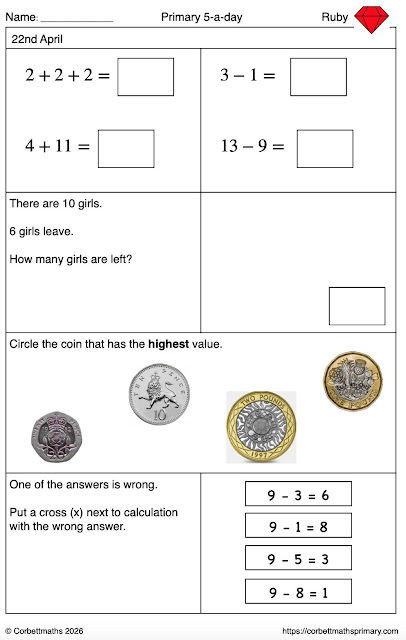
I know that secondary teachers sometimes find these primary resources helpful too (I’m thinking of our Entry Level GCSE classes).
5. A Level Resources
We had a difficult logs and integration question in our Year 13 mock this year that even our strongest mathematicians struggled with, so I’m pleased to see this lovely little task from @mrlevmaths.bsky.social for practising this specific skill.


Other resources on Karen’s website that might be helpful for both Year 12 and L2 Certificate in Further Maths include Factorising with Surds and Graphical Solutions. Thank you Karen!

Big Mathematical Ideas
Colin Foster (one of the wisest men in maths education) has launched a new website: bigmathematicalideas.org. He has written a chapter on each of the five big mathematical ideas.

Reading this website will probably be my summer holiday project, or perhaps something I do in my gained time this term. I will use it to write next year’s professional development sessions for my department.

Update
No doubt you saw that new research on setting in maths was published by the EEF. There are Year 7s in my school who struggle to add single digit numbers, or to multiply integers by ten, and others who find it easy to solve complex algebraic and geometric problems. Teaching these children in the same class doesn’t make any sense to me, and I feel it would particularly let down the students who struggle the most and would benefit from being in a smaller group. Maths teachers are sometimes made to feel like they’re evil or lazy for teaching in sets when they are actually trying to do the right thing for the students who need the most support. The narrative that schools often assign their ‘worst’ teachers to teach the lowest attainers is insulting nonsense. Most Heads of Maths prioritise the students who find maths difficult, and assign absolute superstars to teach them.
Here’s a round up of some recent developments, in case you missed anything:
- Jonny Griffiths has updated his website carom-maths.co.uk which houses a collection of forty activities bridging from A Level Mathematics to University Mathematics. This is a great set of resources for a Sixth Form maths club.
- Maths Genie has had a big update! Set up a free account to access useful resources, like the GCSE mini tests.
- A few teachers have been in touch to ask about the RULER resources from Ben Tanner. These popular resources used to be available on Ben’s website but it no longer exists. Helpfully, Tim Stirrup shared an archived version of the website, where you can still download the booklets.
- The QAMA is back – but this time, as an online version instead of a physical calculator. QAMA requires an estimation before it will work out an answer. It’s great for developing number sense. If students don’t have access to devices to use the online calculator in lessons, it could instead be used by the teacher in modelling.
- Recently I’ve received a fair few emails from teachers who have either used AI to create tools for teachers or have created a platform where students can use AI to support their learning. For example, on gcsemathsai.co.uk students type in any topic or question and get instant step-by-step worked explanations. It covers the full GCSE syllabus and is free, with no account needed. One thing that stood out for me on this website is the misconceptions for each topic (e.g. look at ‘common mistakes’ for inequalities and arc length and sector area) which might be helpful for teachers planning lessons.
- Hannah Fry is going to be on the next Celebrity Traitors (our favourite family viewing – my daughter is obsessed with it)! Cue me telling everyone who will listen about the time Hannah bought me a drink and we hung out at BCME…

Thanks for reading!
View the original article and our Inspiration here