
Every January, the education world is hit with a familiar tsunami. We return from the break, hopefully rested, only to be met by the relentless “New Year, New Initiatives” cycle. It’s like clockwork: a burst of energy to overhaul grading, pivot to new tech, or rewrite behavior plans. But as I’ve shared in Digital Leadership and Disruptive Thinking, we must confront a hard truth: Novelty is not transformation.
If you are chasing the “new” simply because the calendar flipped, you aren’t leading; you’re reacting. In 2026, reactive leadership is a recipe for burnout. To move beyond the buzzwords, we must evolve our leadership DNA.
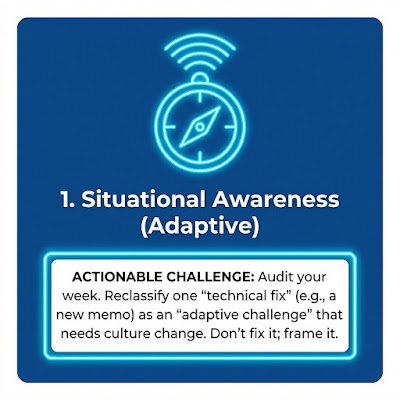
Situational Awareness: Matching the Velocity of Change
In a previous post, I discussed the Adaptability Quotient (AQ), but in 2026, AQ is no longer about being “flexible”. It is about situational awareness. Variables of school leadership now change monthly, if not weekly. Traditional management often misidentifies cultural shifts as technical glitches. In our 2026 landscape, we must transcend the “fix-it” mentality and adopt a Diagnostic Framework for Agile Leadership. Instead of treating student disengagement or staff burnout as bugs to be patched with a new schedule or a digital tool, we must recognize them as signals for deeper, systemic evolution. This requires a radical redistribution of agency.
As DeMatthews, Kotok, and Knight (2021) argue, effective leadership in crisis or high-velocity environments requires a move toward inclusive, distributive models that empower staff to navigate complex, non-linear problems. By decentralizing authority, we allow those closest to the instructional core to respond to shifting variables in real time.
True pedagogical leadership isn’t about being the smartest person at the podium; it’s about creating an ecosystem where everyone is empowered to iterate. By decentralizing authority, we allow those closest to the instructional core to respond to shifting variables in real time. This transforms our schools from static, top-heavy institutions into agile, learning-focused organizations capable of pivoting at the speed of change.
The Rise of AI-Assisted Pedagogical Leadership
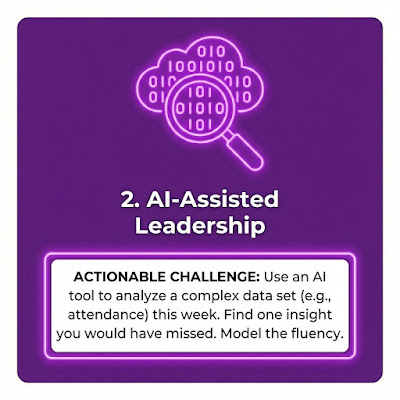
We have moved past the “ban it” brigade and the “wild west” of AI. The new frontier is AI-assisted pedagogical leadership. It isn’t enough for a leader to be “tech-savvy”; you must be pedagogically fluent. This means distinguishing between learning FROM AI (passive consumption) and learning WITH AI (a feedback-driven partnership).
A current study by Zhang and Cheng (2025) found a significant “familiarity gap” where school leaders often feel more comfortable with AI than the teachers they supervise. This gap creates a friction point in implementation. To lead effectively, we must model fluency by using AI to analyze complex datasets, such as attendance or engagement patterns, to uncover insights that human observation alone might miss. This isn’t about replacing human judgment; it is about using AI to amplify high-quality first instruction (HQFI).
The Empathy Paradox in Digitally Augmented Environments
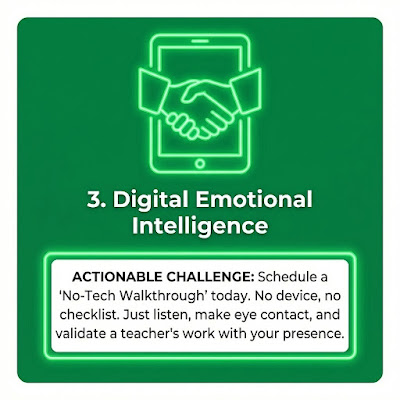
As our schools become more high-tech, our leadership must become more high-touch. I call this the empathy paradox. We are more connected than ever, yet loneliness among staff and students is at an all-time high. Digital emotional intelligence is now a core measurable competency.
Current scholarship in neurocognitive leadership suggests that digitally mediated environments often filter out the rich emotional cues (tone, affect, and presence) essential for affective empathy (Fragouli, 2025). Without intentional “digital empathy,” leaders risk creating cultures of shallow, surveillance-based mimicry rather than genuine care. Leading in 2026 requires “reading the digital room” to recognize that a terse Sunday night email creates a cortisol spike in staff that no “wellness” initiative can undo. We must prioritize “no-tech walkthroughs,” where the device is left in the office and the focus is entirely on human-to-human validation.
Mission-Aligned Narrative Efficacy
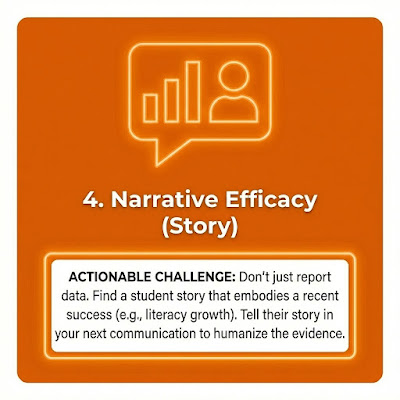
Data without a story is just noise. In Digital Leadership, I introduced the “Storyteller-in-Chief” concept, but today we must focus on narrative efficacy. Stakeholders are increasingly skeptical of institutional claims; they demand evidence grounded in mission-aligned personal stories. Braaten and Farnsworth (2025) highlight that the most effective leaders use “narrative-driven data” to align stakeholder perceptions with actual classroom transformation, ensuring that innovation is seen as a human outcome rather than a clinical metric.
Personal storytelling is a strategic bridge. It’s the difference between reporting a 5% growth in literacy scores and telling the story of a student like “Michael,” who found his voice through a specific phonics intervention. Evidence-based storytelling humanizes our roles and reaffirms the values that define our schools. In a world of skepticism, your narrative is your compass.
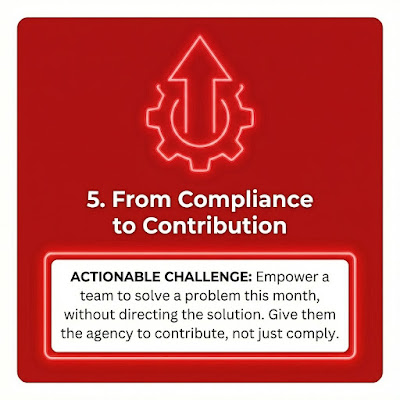
The Agency Shift: From Compliance to Contribution
Ultimately, the goal of disruptive thinking is to move school culture from compliance to contribution. Compliance keeps the machine running, but it doesn’t spark innovation. When we shift toward contribution, we move from “doing school” to “empowering learners.” Research by Karakus, Toprak, and Chen (2025) demonstrates that when leaders move from top-down mandates toward fostering teacher agency, organizational commitment and instructional quality rise significantly.
Transformation isn’t an event; it’s a process of layer-by-layer growth. This year, don’t just look for something new, look for something better.
Braaten, M., & Farnsworth, S. (2025). School leaders and AI-driven education: A comparative study of readiness, perceptions, and implementation strategies. Emerald Insight: Journal of Educational Administration, 63(1), 45-62.
DeMatthews, D., Kotok, S., & Knight, D. S. (2021). Adaptive Leadership During a Crisis: A Case Study of a Principal’s Response to COVID-19. Journal of Cases in Educational Leadership, 24(1), 16–29.
Fragouli, E. (2025). Digital empathy and AI: Can machines support employee well-being in the workplace? Journal of Media & Management, 7(7), 1-12.
Karakus, M., Toprak, M., & Chen, J. (2025). From compliance to commitment: A quantitative study of educational leadership’s influence on teacher motivation and agency. ResearchGate: International Journal of Educational Leadership, 18(2), 114-131.
Zhang, L., & Cheng, Y. (2025). The rise of AI-assisted instructional leadership: An empirical survey of global school leadership trends. Frontiers in Education, 10, Article 1643023.
View the original article and our Inspiration here